SPA(Smart Personal Assistant): Empowering supply chain managers with AI-driven automation, real-time insights, and data-driven strategies for smarter, faster decisions.
Supply Chain Management
Period
03/25/2025 - 04/04/2025
Target Audience
Supply Chain Managers, Procurement Teams and Operations Managers

Study
Challenges
User Studys
Stakeholders

Analysis
Benefits
User Journey
High-Level Architecture

Measure Success
Desired Outcome
Value Proposition
Solutions to be Integrated

Output
Demo Video
Demo Prototype
Special & Priority
Sophia Carter, a Supply Chain Manager, faces daily inefficiencies in procurement, inventory management, and supplier coordination. Extracting key insights requires navigating multiple spreadsheets and scattered reports. Approvals are slow, involving manual emails and endless follow-ups. Responding to supplier delays is cumbersome, requiring multiple phone calls and time-consuming investigations. These manual processes slow decision-making, create bottlenecks and reduce overall efficiency.
Data Overload: Too much information showing daily, making it time-consuming to extract key insights.
Slow Decision-Making: Requires multiple steps to approve purchase orders, adjust suppliers, or track performance.
Supplier Delays & Unpredictability: Handling disruptions and ensuring production continuity.
Manual & Repetitive Tasks: Routine approvals, reordering, and reporting slow down efficiency.

Supply Chain Manager
38 years old
Chicago, IL
Mid-size Manufacturing Firm
MBA in Operations Management
ERP Systems (SAP, Oracle), Data Analytics
Analytical, Detail-Oriented, Proactive, Strategic Thinker
I interact with suppliers, but my main responsibility is ensuring the company gets the right materials at the right time to keep operations running smoothly.
Goals:
Oversee End-to-End Supply Chain Operations – Ensuring smooth procurement, supplier coordination, and inventory management.
Optimize Cost & Efficiency – Balancing cost savings with supply chain resilience.
Leverage New Technologies – Using technology to reduce manual work and improve decision-making speed.
Mitigate Supply Chain Risks – Identifying and resolving disruptions quickly.
Product Owner
Scrum Master
AI/ML Engineers
Data Engineers
Backend Developers
Frontend Developers
UX/UX Designers
Quality Assurance (QA) Engineers
Business Analysts (optional)
DevOps Engineers (Optional but Recommended)
Enhanced Efficiency: Companies leveraging AI assistants report a 30% increase in user satisfaction and a 20% reduction in process cycle times.
Source from ResearchGate
Improved Decision-Making: AI continuously analyzes data to identify inefficiencies and optimize workflows.
Source from ResearchGate & Top10ERP
Reduced Supply Chain Disruptions: Early adopters of AI in supply chain management have reported a 15% reduction in logistics costs, a 35% improvement in inventory levels, and a 65% enhancement in service levels.
Source from Georgetown Journal
Accelerated Reporting: AI enables faster data processing and reporting, leading to timely insights and informed decision-making.
Source from IBM
Cost Savings: AI integration in supply chains has significantly reduced costs, with organizations noting decreased expenses and improved financial performance.
Error Reduction: Automating routine tasks minimizes human errors and ensures accurate, reliable data.
Without SPA AI: ASophia spends hours tracking inventory, chasing approvals, and manually handling supplier delays. Extracting insights from reports is tedious, leading to slow decision-making and missed opportunities.
With SPA AI: The AI-powered assistant automates key workflows, summarizes insights instantly, and proactively alerts Sophia to potential issues. Supplier delays are flagged early, with AI-driven recommendations for alternatives. Approvals are completed in seconds, freeing up valuable time for strategic decision-making.
| User Steps | User Actions | Goals & User Needs | Feelings & Thoughts | 😖 Pain Points | 🎯 Opportunities with AI |
|---|---|---|---|---|---|
| Morning Status Check | Checks multiple reports and data sources to track supply chain updates. | Needs a quick summary of critical supply chain updates | I need to see what's urgent today, but this takes too long. |
Time-consuming, too much data to sift through. | ✅ Smart Summarization - AI provides a concise daily update on orders, inventory, and supplier statuses. |
| Reviewing Supplier & Inventory Issues | Manually checks inventory reports, identifies low-stock items, and emails the procurement team. | Ensure materials are available to avoid delays | I hope we're not running low on critical materials. |
Data is not consolidated, requiring multiple clicks. | ✅ Proactive Alerts & Suggestions - AI flags low-stock items and recommends reorders with a single click. |
| Approving Purchase Orders | Searches for pending orders, reviews details one by one and approves manually. | Keep procurement running smoothly without bottlenecks | Approving these orders takes too many steps. |
Approval process is slow and repetitive. | ✅ Automated Approvals - AI recommends approvals based on past decisions and auto-approves routine orders. |
| Handling Supplier Delays | Gets notified about a delayed shipment via email, calls supplier, checks impact, and updates teams manually. | Quickly assess and resolve delays to avoid production downtime | This delay might impact production. Do we have alternatives? |
Time-consuming, too much data to sift through | ✅ AI-Driven Supplier Insights - AI suggests alternative suppliers, compares costs and allows instant order adjustments. |
| End-of-Day Reporting & Fellow-ups | Gathers data from multiple sources, compiles reports, and emails updates to stakeholders. | Provide clear updates to management and track KPIs. | Pulling all this data together is exhausting. |
Reporting is manual, time-consuming, and prone to errors. | ✅ AI-Generated Reports - AI complies with reports automatically and sends summaries to stakeholders. |
Sophia interacts with suppliers daily, but her main responsibility is ensuring her company gets the right materials at the right time to keep operations running smoothly.
Managing Purchase Orders: Reviewing and approving supplier orders.
Ensuring Inventory Availability: Reordering raw materials when stock is low.
Handling Supplier Delays: Finding alternative suppliers if shipments are late.
Optimizing Costs & Efficiency: Making procurement decisions based on budgets and supplier performance.
With an AI-powered assistant, Sophia’s workflow becomes seamless. The AI summarizes key data, automates repetitive approvals, and proactively alerts her to supplier delays, offering alternative solutions. Decision-making is now faster, manual effort is minimized, and supply chain operations become more resilient. This transformation enables Sophia to focus on strategic planning rather than getting bogged down by daily operational hurdles.
Efficiency Boost: Reduces manual work with automation.
Faster Decision-Making: AI-driven insights enable quick actions.
Proactive Risk Management: Flags supplier delays and suggests alternatives.
Enhanced User Experience: Conversational AI streamlines complex workflows.
Automated Reporting: Generates real-time reports for stakeholders.
AI-driven Assistant: Smart summarization and workflow automation.
Predictive Analytics: Forecasts supply chain risks and provides recommendations.
Automated Approval System: Reduces repetitive manual approvals.
Supplier Performance Monitoring: AI-driven insights into supplier reliability and alternative suggestions.
To Company: AI leverages big data and machine learning to enhance decision-making, automate tasks, and optimize operations. It improves efficiency, personalizes user experiences, and boosts profitability by predicting trends, streamlining workflows, and adapting to customer needs.
To Customer: AI creates a more innovative, personalized experience by predicting preferences, automating support, and optimizing services. It ensures faster, more intuitive interactions, better deals, and seamless user experiences tailored to individual needs.
Requirements for Building up: Cloud Data is ready, AI tool branding is prepared, and the product is ready!
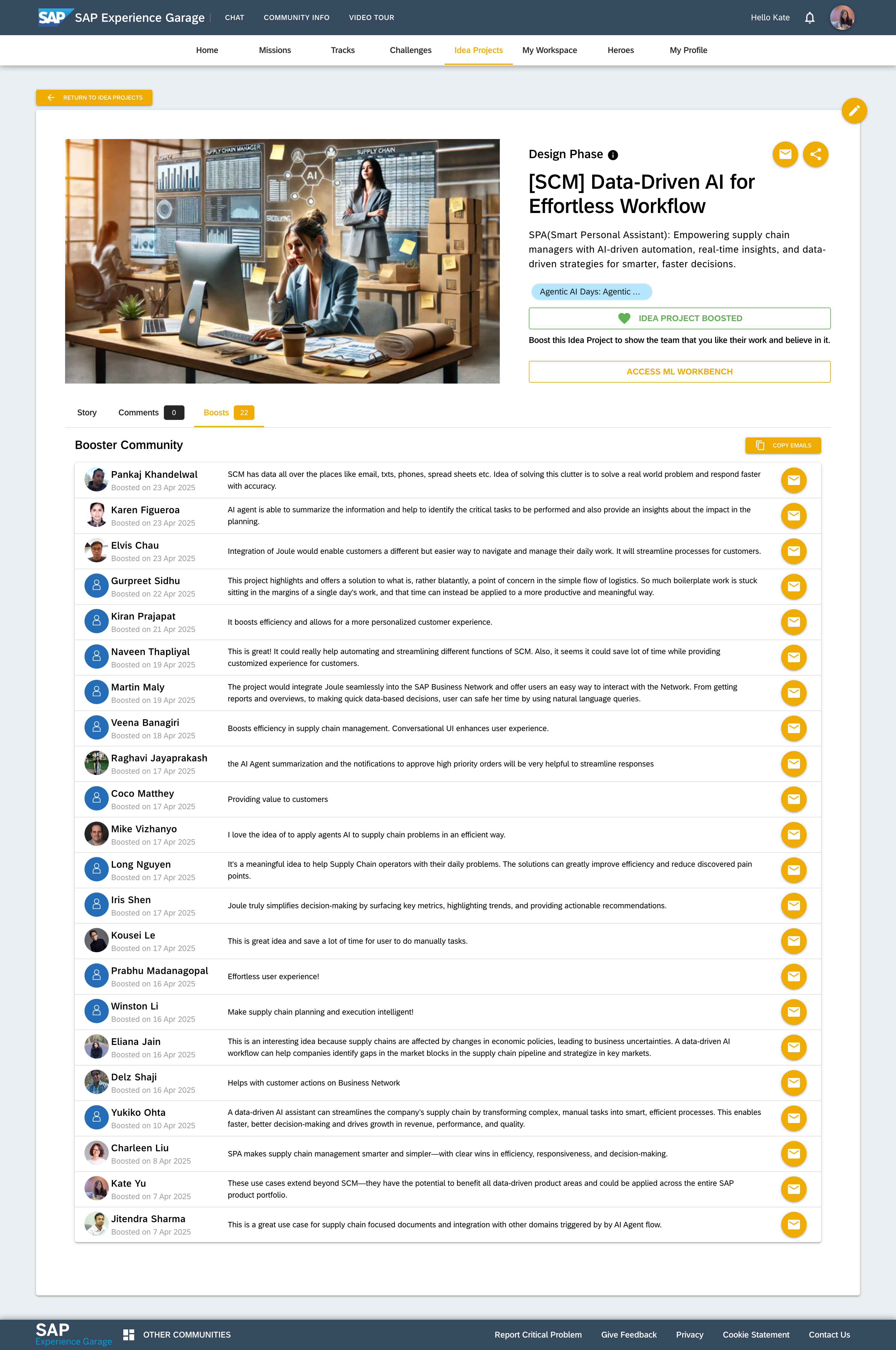
The AI Hackathon was a valuable learning experience filled with challenges and breakthroughs. A key hurdle was integrating AI seamlessly into existing workflows without disrupting user habits or slowing down processes. Users were hesitant to trust AI suggestions, so transparency and usability were crucial. Through testing and feedback, we found that AI works best as an assistant, enhancing efficiency rather than replacing decisions. The key takeaway? AI should be intuitive, solve real pain points, and streamline tasks without adding complexity.
AI Boosts Efficiency – Reduces task time by up to 40% through automation and smarter workflows.
User-Centered Design Matters – AI should simplify tasks, not complicate them.
Trust & Adoption Are Challenges – Clear, explainable AI builds user confidence.
Logical Thinking is Key – Design skills alone aren't enough, strong logical thinking and pre-planning are essential for a successful designer in the future.
Click to see the detail